
TikTok Shop November GMV Sprint: what are the rewards worth?
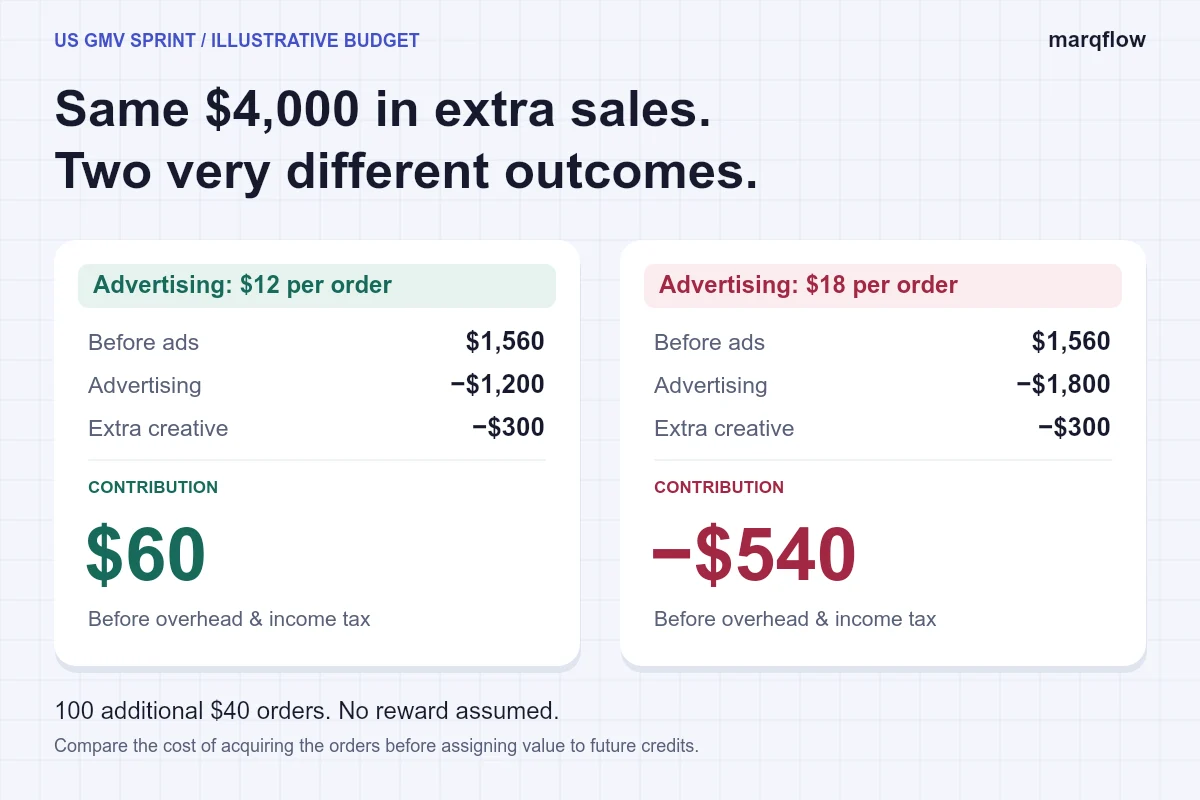
The TikTok Shop November GMV Sprint can reward invited US sellers for sales growth, but a leaderboard push still needs a profitable budget. Calculate the extra orders without a reward first. Treat any advertising credit as a separate upside case until the award, restrictions and usable amount are confirmed. A larger sales total can leave less money if you buy those orders at a higher cost.
The short version
- Confirm your invitation and assigned reward cohort before budgeting a push.
- Calculate contribution on the extra orders with no advertising-credit award.
- Value a confirmed credit by the eligible spending it can actually replace.
November GMV Sprint dates and reward tiers
The official November terms, dated November 2, specify registration and competition from November 4 through November 30, 2026, in UTC-0. Use that timezone when checking the cutoff.
| Invited cohort | Rewarded ranking places | Credit up to |
|---|---|---|
| Startup | Top 130 sellers | $1,500 |
| Rising | Top 160 sellers | $3,000 |
| Accelerating | Top 150 sellers | $5,000 |
Participants must be invited US sellers, at least 18 and registered. The terms require at least $100 incremental GMV, SPS of 3.5 or above, and an active shop at the end. Meeting a minimum is not the same as achieving a rewarded rank.
For example, a $12,000 result against a $10,000 baseline gives $2,000 of program growth. This arithmetic does not establish a winning rank or prove that advertising caused the increase. Seasonality, organic traffic, pricing and product availability can change between the periods.
An ads credit does not fund today's inventory
The Sprint terms say awards go to the linked primary ads account within 10 business days after the sprint ends, with rewards under Seller Center > Growth > My Rewards. That timing matters when you pay suppliers and advertising bills during the promotion.
TikTok's Advertising Credit Terms describe credits as non-refundable, without cash value, and usable only for new advertising rather than outstanding debts. An unawarded credit cannot pay this week's warehouse invoice. Keep the cash needed for the sales plan separate from the possible later advertising benefit.
The current ad-credit guide distinguishes free, assignable and conditional credits. Check the issued credit's usage requirements, valid dates and restrictions. Do not assume the Sprint award can fund every campaign or that you will use its full face value before expiry.
Budget 100 extra orders before counting a reward
Use a hypothetical US product selling for $40 with no seller discount, platform subsidy, buyer-paid shipping or sales tax included in revenue. Assume $12 product cost, $5 outbound fulfillment, a chosen 10% creator commission and a $1 expected net return-loss allowance per order. The allowance includes the modeled net effect of returns once.
Use a 6% referral fee for this example, consistent with the published US policy; confirm your category and account rate. Both percentage charges use the $40 item price here. Before ads, contribution is $40 − $12 − $5 − $4 − $2.40 − $1 = $15.60 per order.
Now suppose a push brings 100 additional orders and requires $300 of extra creative work. Compare two advertising costs per acquired order: $12 and $18. These are planning assumptions for the cost comparison; your own result and leaderboard position can differ. Include any campaign, Smart Promotion or other program charges separately; none are included below.
| 100-order scenario | $12 ad cost / order | $18 ad cost / order |
|---|---|---|
| Extra item revenue | $4,000 | $4,000 |
| Product, fulfillment, fees, creators and return allowance | $2,440 | $2,440 |
| Contribution before ads | $1,560 | $1,560 |
| Advertising spend | $1,200 | $1,800 |
| Additional creative cost | $300 | $300 |
| Contribution after the push | $60 | −$540 |
At this order count, $300 of creative adds $3 per order. The all-in break-even advertising limit is therefore $15.60 − $3 = $12.60 per order. The $12 plan clears it by just $0.60. The $18 plan spends $5.40 too much per order, producing the $540 loss.
Changing volume changes the allocation. At 50 extra orders, the same creative bill is $6 per order and leaves only $9.60 for advertising at break-even. At 200 orders, creative is $1.50 and the ceiling becomes $14.10. Keep these costs attached to the volume assumption instead of copying a CPA limit from a much larger forecast.
Value credits by the future spend they replace
Suppose the business eventually receives a $500 credit, a chosen example amount. Before the award, it should still show the $540 downside from the higher-CPA plan. If the credit replaces only $350 of already planned, eligible cash advertising before expiry, its modeled saving is $350. Across the push and later credit use, the combined change remains −$540 + $350 = −$190, before overhead.
Even using all $500 leaves a $40 shortfall in this example. Recovering the original loss requires at least $540 of usable savings with no additional costs. Spending more simply to consume a credit creates a new campaign decision; it does not make the old orders profitable.
Maintain three separate figures: operating contribution from the push, confirmed usable advertising savings, and actual cash available. Do not subtract the credit from ad cost and add it again as revenue.
Check credit settings before the next campaign runs
TikTok's credit-management instructions direct advertisers to Tools > Billing > Payment > Promotions in Ads Manager. They also warn that spending can move to cash or credit balance when promotional credits expire or run out. An exhausted reward is not a spending cap.
- Save your invitation, assigned cohort, current terms and registration confirmation. Record the program's baseline before setting a target.
- Model the extra orders without a reward. Use the discounted seller revenue, creator terms, fulfillment and a mature return estimate for the exact offer.
- Set a cash spending limit and a review point that the business can fund even if no award arrives.
- When credit is issued, confirm its amount, dates, eligible campaigns and any assignment requirement in the linked ads account.
- Review campaign budgets before the credit runs out. Reconcile actual spending and deductions after the push rather than using the sales headline as profit.
Use the US profit calculator to find the contribution available for advertising. Keep the one-time creative budget separate when comparing campaign totals. The break-even CPA guide explains the per-order limit; the settlement-report guide covers the later reconciliation.
If the push also uses a product promotion or coupon, calculate its funding with the coupon-stacking walkthrough. Lower retained revenue can move the CPA ceiling before the ad campaign spends its first dollar.
Questions sellers ask
Does meeting the minimum guarantee a GMV Sprint reward?
No. Qualification and ranking are separate. Build the no-award case before increasing spend, and confirm the actual result before counting a reward.
Should I deduct an expected credit from today's ad cost?
Keep an unawarded credit outside the base operating forecast. Model it separately once its amount and usable savings are confirmed, and do not count the same benefit twice.
Can higher GMV leave lower profit?
Yes. In the illustrative 100-order comparison, the same $4,000 of extra item revenue leaves $60 at $12 ad cost per order or a $540 loss at $18, after the stated costs and $300 creative budget.
Sources and verification
Platform rules can change. Examples use stated assumptions; your current Seller Center terms take precedence.
- TikTok Shop US — 2026 November GMV Sprint termsChecked
- TikTok for Business — Advertising Credit Terms and ConditionsChecked
- TikTok for Business — Ad credit types, restrictions and valid datesChecked
- TikTok for Business — Manage ad credits and payment fallbackChecked
- TikTok Shop US — Referral fee policy and category-rate guidanceChecked
 Put the guide into numbers
Model your own product economics.
The marqflow profit calculator includes platform fees, creator commission, ads, fulfilment, returns and break-even analysis.
Open the free calculator