
TikTok Shop coupon stacking: what US sellers actually pay
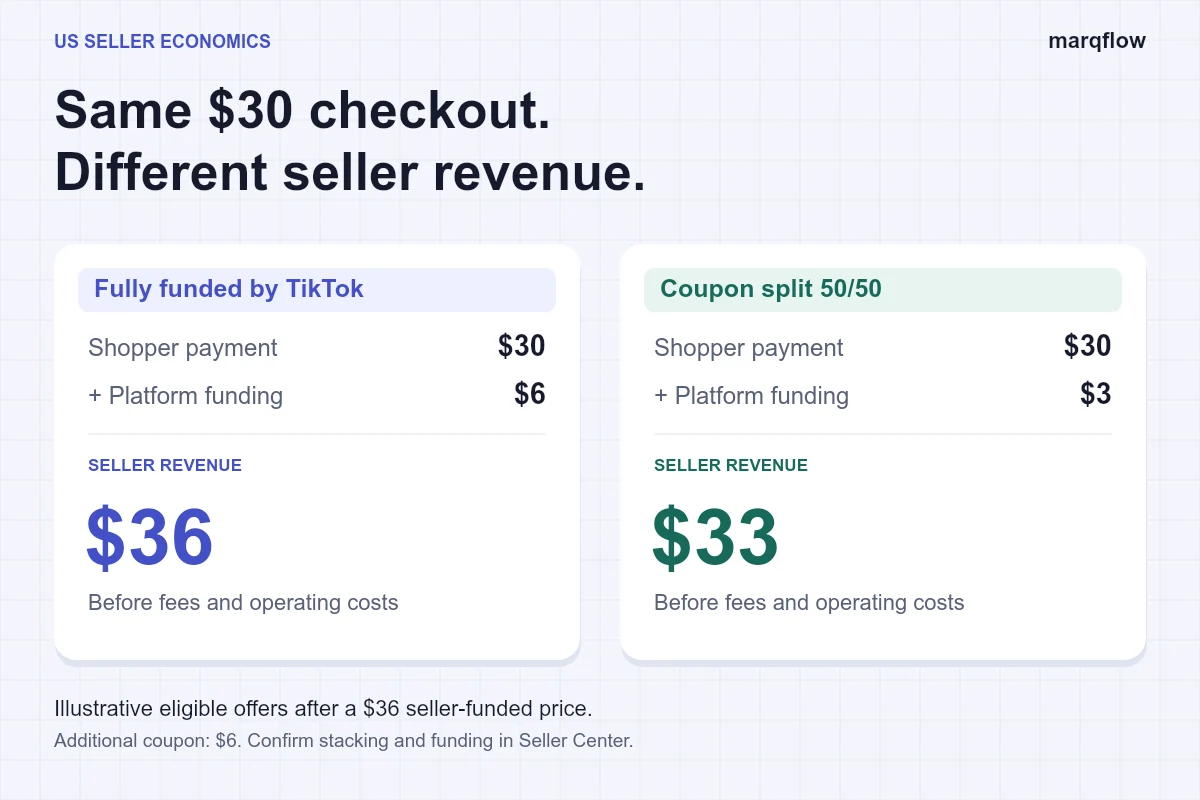
A TikTok Shop seller coupon can stack with some product and cart promotions, but two seller coupons cannot apply to the same order. The important profit question is who funds each discount. A customer paying $30 can leave you $36 before fees if TikTok funds the difference, or $33 if you share that coupon's cost. Check the eligible combination in Seller Center, then calculate what the seller-funded price leaves after costs.
The short version
- Check promotion compatibility separately from who pays for the discount.
- Use the seller-funded price, not just the buyer's payment, when planning revenue.
- Recalculate fees, creator commission and contribution before adding another offer.
How TikTok Shop coupon stacking works
TikTok's US seller-coupon guide limits an order to one seller coupon. Its separate promo-code instructions also say the buyer must choose between a seller coupon and a promo code. A follower coupon plus a public seller coupon is not a way to apply both discounts to one order.
Different promotion layers can interact. The US product-card guide distinguishes a product price, a cart-level offer and checkout coupons. For example, it lists Seller Flash Sale plus Seller Coupon as compatible, while a campaign price takes priority over a regular flash sale. A product discount and a flash sale should not simply be added together.
| Combination | What to check |
|---|---|
| Two seller coupons | One applies per order |
| Seller coupon + promo code | The buyer uses one or the other |
| Seller Flash Sale + seller coupon | Can stack; budget the coupon on the applicable discounted amount |
| Campaign price + regular flash sale | Campaign price takes priority |
| Co-funded campaign coupon + seller coupon | The standard-registration guide permits stacking; confirm the campaign's eligibility and funding terms |
TikTok's standard-registration guide specifically permits co-funded campaign coupons alongside seller coupons. That does not mean every platform benefit combines with every seller promotion. Save the actual campaign notice and checkout breakdown rather than relying on an old stacking chart.
Separate the shopper's saving from your contribution
A seller-funded coupon reduces the amount you retain. TikTok describes TikTok-funded promotions as discounts paid for by the platform. A co-funded coupon splits the cost according to the offer's contribution ratio. Read that ratio and any funding cap before treating the entire discount as a subsidy.
For co-funded offers, the standard-registration guide says your share is deducted from the order payout and the Order Details page separates seller and platform promotions. Record both amounts. A crossed-out retail price or a very low shopper payment is not enough to reconstruct your revenue.
A $50 product can reach $36 before a platform coupon
Take a chosen $50 retail price. Suppose an eligible seller product promotion reduces it by 20% to $40, then a seller coupon takes 10% off that $40. The coupon costs $4, leaving $36. The combined seller-funded reduction is $14, or 28% of the original price. Adding 20% and 10% would incorrectly predict a $35 price.
Now compare two additional $6 coupon offers, assuming Seller Center confirms that each is eligible to stack in its respective scenario. One is fully funded by TikTok; the other is split equally between seller and platform. These are alternative planning cases, not simultaneous coupons, advertised offers or a claim about your account's eligibility. Exclude sales tax and buyer-paid shipping throughout.
| Amount per order | Fully platform-funded $6 coupon | 50/50 co-funded $6 coupon |
|---|---|---|
| Price after the seller's product promotion and $4 coupon | $36.00 | $36.00 |
| Additional coupon saving for the shopper | $6.00 | $6.00 |
| Seller share of that additional coupon | $0.00 | $3.00 |
| Platform share of that additional coupon | $6.00 | $3.00 |
| Shopper pays | $30.00 | $30.00 |
| Seller revenue before fees | $36.00 | $33.00 |
The platform-funded case does not create $6 of extra revenue on top of $36. The $6 bridges the gap between the customer's $30 payment and the $36 seller-funded price. In the shared case, TikTok contributes only $3, so revenue is $33 before deductions.
Calculate profit after the stacked discounts
Use illustrative costs of $14 for the product, $5 for outbound fulfillment, $6 advertising per acquired order and a $1 expected net return-loss allowance. These fixed-dollar amounts total $26 per order. They are planning inputs, not US market averages. Contribution here is what remains before fixed business overhead and income tax.
Assume a 6% referral fee and a chosen 10% creator commission, both applied to seller revenue in this example. The US referral policy defines the fee basis using customer payment plus platform discount minus tax. Confirm your category rate and the creator arrangement's actual commission basis. No additional campaign, Smart Promotion or other program charge is included below; add any that apply to your order.
| Item | Fully platform-funded coupon | 50/50 co-funded coupon |
|---|---|---|
| Seller revenue before fees | $36.00 | $33.00 |
| Referral fee at assumed 6% | $2.16 | $1.98 |
| Creator commission at chosen 10% | $3.60 | $3.30 |
| Product cost | $14.00 | $14.00 |
| Outbound fulfillment | $5.00 | $5.00 |
| Advertising | $6.00 | $6.00 |
| Expected net return-loss allowance | $1.00 | $1.00 |
| Contribution before overhead and income tax | $4.24 | $1.72 |
The extra $3 seller contribution to the coupon reduces order contribution by $2.52 here: percentage-based fees also fall by $0.48 under the stated assumptions. Across 500 otherwise identical orders, contribution would be $2,120 versus $860, a $1,260 difference. Actual volume, returns and fee bases can change the comparison.
If your chosen minimum is $4 contribution per order, the fully platform-funded case has only $0.24 of room. The co-funded case misses that target by $2.28 before any omitted charge. More orders at the lower contribution do not automatically solve the shortfall; calculate the extra volume required and whether you can fund it.
Use Promotion Simulator before changing the offer
TikTok's current Price Watch guide directs US sellers to Seller Center > Marketing > Promotions > Price Watch, also accessible from Campaigns. Use Promotion Simulator for compatibility and priority, then Price Forecast for the estimated shopper price across the offer period. Neither is a replacement for your product-cost and advertising calculation.
- Choose the exact SKU, promotion dates and customer group. Record the product price that wins when offers overlap.
- Check the seller coupon or promo code, its minimum spend and cap, and whether a cart offer changes eligibility. Use the calculated checkout amount rather than adding percentage labels.
- Record the seller and platform shares of any additional campaign coupon. Include applicable program charges, seller-paid shipping and creator costs.
- Calculate contribution at that price. Set a redemption budget and a review point before increasing exposure.
- After orders settle, compare the saved forecast with Order Details and actual deductions. Update the model when funding, shipping, fees or returns differ.
Price Watch's Safety Level Monitor is also useful, but TikTok says real-time removal applies only to eligible platform-funded Product Incentives. Other platform promotions and seller-funded promotions are monitored, not automatically blocked. Setting a Safety Price is not a guarantee that every low-price order will be prevented.
Put the final seller-funded offer into your margin model
For the fully funded example, a $50 price and 28% total seller-funded discount produce $36 seller revenue. For the shared example, the combined seller-funded reduction is $17, or 34%, leaving $33. Entering 20% + 10% as a 30% discount would misstate the first offer; entering the shopper's full 40% saving as your own discount would ignore the platform funding.
Use Marqflow's US profit calculator to compare the effective seller-funded price with your product, creator, advertising and fulfillment costs. Enter subsidies only once. The calculator does not determine TikTok promotion eligibility or reproduce its checkout engine. Use your actual return assumptions rather than copying the example's $1 allowance as a percentage.
If the offer includes a multi-buy tier, use the separate Buy More Save More guide to cost the basket. For campaign enrollment and seasonal charges, read the US Black Friday seller guide. After payout, the settlement-report walkthrough helps reconcile the figures.
Questions sellers ask
Can two TikTok Shop seller coupons stack?
No. The US seller-coupon guide allows one seller coupon per order. A promo code also competes with a seller coupon rather than adding another seller-coupon discount.
Do TikTok-funded coupons reduce the seller's revenue?
For a fully platform-funded coupon, confirmed funding covers the coupon amount. A co-funded coupon reduces seller revenue by the seller's share. Check Order Details, applicable charges and the specific offer instead of treating every platform coupon as fully funded.
Why can the same checkout price leave different profit?
Funding can differ. In the illustrative $30 checkout examples, $6 of platform funding leaves $36 revenue before fees; a $6 coupon split equally leaves $33. After the stated costs, contribution is $4.24 versus $1.72.
Will Price Watch automatically block all discounts below my Safety Price?
No. TikTok says real-time removal applies only to eligible platform-funded Product Incentives. Other platform and seller-funded promotions are monitored rather than automatically blocked.
Sources and verification
Platform rules can change. Examples use stated assumptions; your current Seller Center terms take precedence.
- TikTok Shop US — How to Use Seller CouponChecked
- TikTok Shop US — How to Use Promo CodesChecked
- TikTok Shop US — Product-card promotion layers and priorityChecked
- TikTok Shop US — Standard registration and co-funded coupon contributionsChecked
- TikTok Shop US — TikTok-funded PromotionsChecked
- TikTok Shop US — Referral fee policy and calculation basisChecked
- TikTok Shop US — Price Watch and Promotion SimulatorChecked
 Put the guide into numbers
Model your own product economics.
The marqflow profit calculator includes platform fees, creator commission, ads, fulfilment, returns and break-even analysis.
Open the free calculator