
A TikTok Shop reserve is money from your orders that TikTok temporarily keeps back to cover possible returns and refunds. For US sellers, the standard reserve period runs for 30 calendar days from delivery. Unused funds then become eligible for release; that date is not a promise that the money will reach your bank the same day.
The short version
- Standard US reserve period: 30 calendar days from delivery
- Illustrative extra cash gap: $2,200 above the normal payout delay
- Cash Flow Planner: one sale-to-usable-cash delay
You still have bills to pay during that wait. Before ordering more stock, find out how much is held, when it is expected back, and how that timing affects the cash in your bank. Start with the reserve records in Seller Center.
Find the held amount and its release date
In Seller Center, go to Finances → On hold → Unreleased reserves. Look for the amount held, the collection date and the expected release date. You can also export the Reserve Details sheet through Finances → Statements → Export. The menu labels may vary a little between versions.
Match each record to the original order, then note what was held, what has been released and what is still outstanding. Check the reason shown for each amount. Some orders are on hold because they are awaiting delivery or settlement; those amounts are not necessarily reserve funds.
A smaller payout does not tell you the profit
A hold can make a payout look disappointing even when the order itself is profitable. Work out the order's margin from the sale, fees and actual costs. Track the held money separately as cash you cannot spend yet. The hold itself does not create another fee.
If TikTok uses part of that money for a customer refund, record the refund once. When unused funds are released, match them to the original order instead of counting them as a new sale. The settlement-report guide explains how to reconcile those entries.
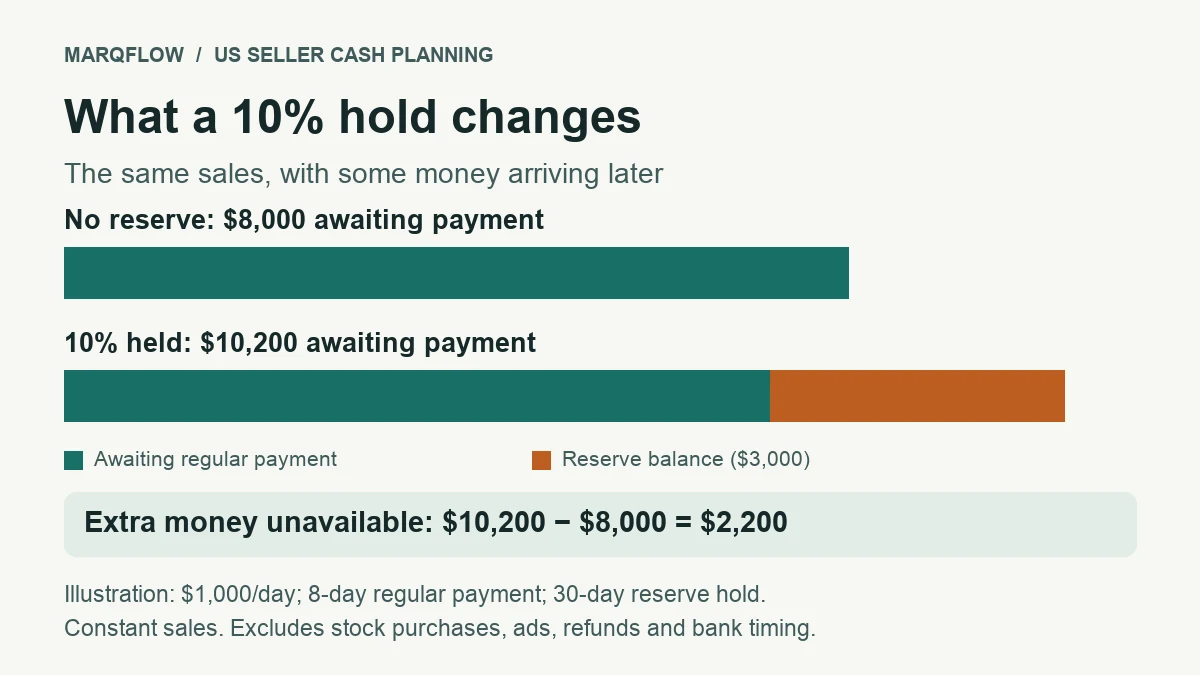
What a 10% hold does to $1,000 a day
Suppose $1,000 a day is due to your shop after order-level deductions, before any reserve is taken. In this example, 90% is released eight days after delivery and 10% on day 30. These are planning assumptions. Use the timing and percentage shown for your own account.
With sales holding steady, $900 from each day's orders waits eight days and $100 waits 30. That leaves roughly $7,200 awaiting regular payment and $3,000 held in reserve: $10,200 in total. Compare this with receiving the full amount after eight days.
| Amount or timing | No reserve | 10% reserve |
|---|---|---|
| Regular amount per day | $1,000 | $900 |
| Days until regular release | 8 days | 8 days |
| Awaiting regular payment | $8,000 | $7,200 |
| Amount held each day | $0 | $100 |
| Reserve hold from delivery | Not applicable | 30 days |
| Reserve still held | $0 | $3,000 |
| Total waiting for release | $8,000 | $10,200 |
| Extra compared with no reserve | $0 | $2,200 |
Without a reserve, eight days of payments would already be waiting: $1,000 × 8 = $8,000. The hold adds $2,200 to that amount, since $10,200 − $8,000 = $2,200. Of the $3,000 reserve, $800 would have been waiting during the normal eight-day delay anyway.
This leaves an extra $2,200 unavailable while sales and terms stay unchanged. It is not your total funding requirement. You still need to allow for stock payments, ads, operating bills, refunds, and the time needed for delivery and bank processing.
When an expected release has not arrived
If an expected release is missing, check the order ID, held amount and release entries before contacting support. Keep the export and the relevant dates together so you can point to the exact transaction. Also check whether the funds have been released but are still moving through the bank.
Read any account restriction notice separately. An enforcement hold can follow different rules from an ordinary reserve. TikTok reviews reserve levels and settlement tiers monthly and may change them earlier because of account status or security checks. Check your current terms before relying on last month's payout pattern.
Put the dates into your cash budget
Use the Marqflow Cash Flow Planner to budget the rest: stock purchases, launch spending and bills that fall due before payouts arrive. Enter the time from sale to usable cash. Keep the reserve calculation above alongside that budget, because the planner uses one payout delay rather than separate dates for held and unheld money.
The Extra funding buffer field adds your own contingency to the modeled minimum. It does not set or reproduce TikTok's reserve rate. Before placing your next stock order, check the lowest cash balance in your forecast and leave room for delays.
Sources and verification
Platform rules can change. Examples use stated assumptions; your current Seller Center terms take precedence.
- Dynamic Settlement and Reserve PolicyChecked
- Finances Page FAQChecked
- How to View Your Reserve RecordChecked
- Seller Enforcement PolicyChecked
 Put the guide into numbers
Model your own product economics.
The marqflow profit calculator includes platform fees, creator commission, ads, fulfilment, returns and break-even analysis.
Open the free calculator